Anthropic released Claude Design on April 17. The product is interesting. What it does to who gets to call themselves a designer is more interesting.
On its face, this is a Figma-and-Canva story — another AI-native design tool entering a crowded category. The more durable read is about user-base expansion: Claude Design hands the kind of polished visual output that used to take a designer (and a week) to founders, product managers, and marketers who never opened Figma. The competitive story is about incumbents. The job-market story is about what design work actually becomes.
What Anthropic actually shipped
Claude Design is a prompt-to-prototype product from Anthropic Labs, powered by Claude Opus 4.7. It launched in research preview for Claude Pro, Max, Team, and Enterprise subscribers at no additional cost, with usage drawn from existing subscription limits. You describe what you want, Claude produces a first version, and you refine through conversation, inline comments, direct text edits, or adjustment sliders the model generates on the fly.
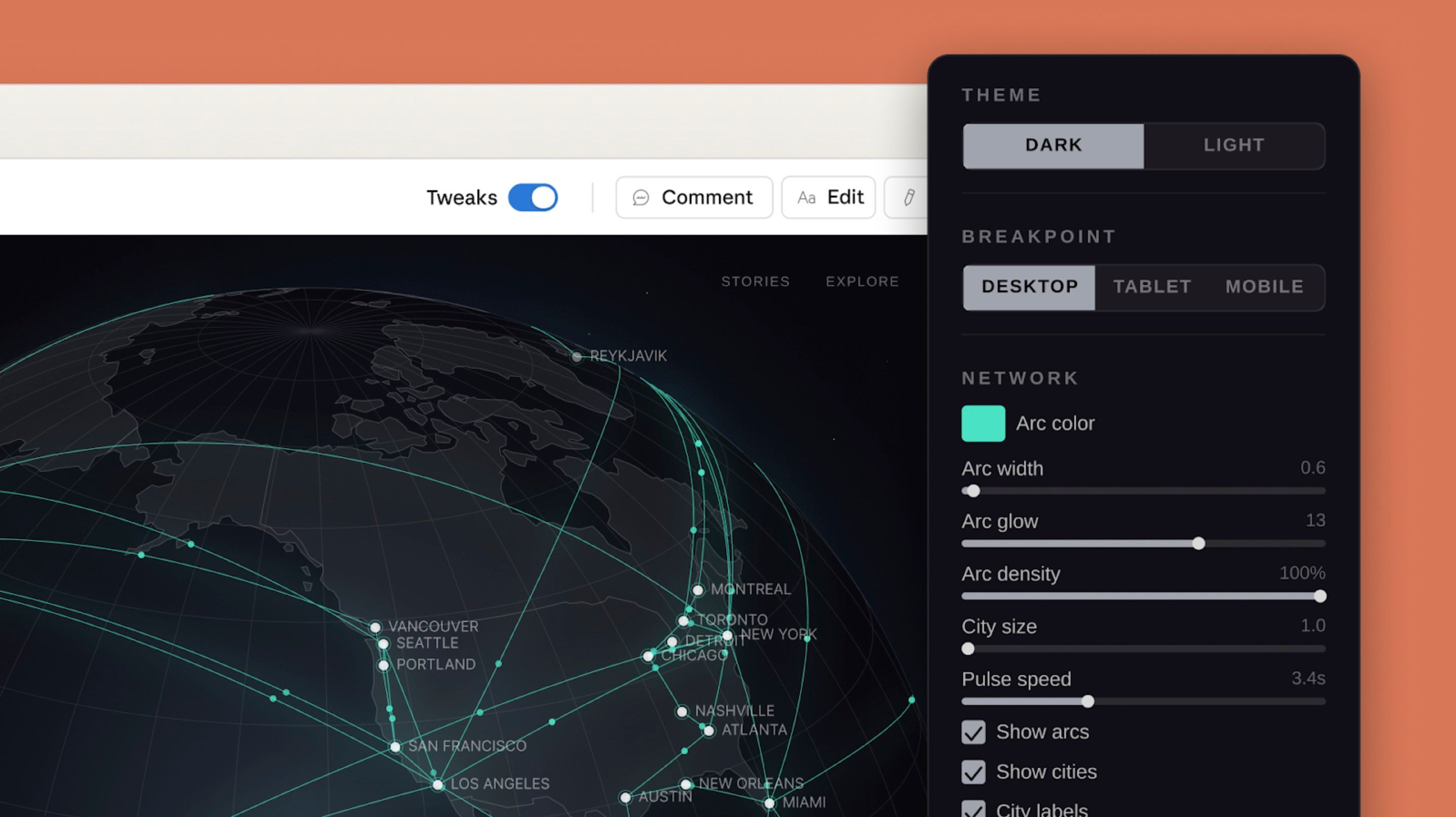
During onboarding, Claude reads a team’s codebase and design files and builds a design system — colors, typography, components — that auto-applies to every subsequent project. Teams can maintain more than one system. Imports are broad: text prompts, images, DOCX/PPTX/XLSX documents, a web capture tool that pulls elements from a live site, or a direct pointer to your codebase. Exports are similarly flexible: internal URL, folder, PDF, PPTX, standalone HTML, or Canva handoff.
The feature that separates Claude Design from the year’s noise of AI design experiments is the production bridge. When a prototype is ready to build, Claude packages the design into a handoff bundle that passes to Claude Code with a single instruction. Exploration to prototype to production code, all inside Anthropic’s stack. That closed loop is the point.
The Figma question
Anthropic’s public framing is that Claude Design complements existing tools rather than replaces them — hence the Canva export, the PDF and PPTX outputs, and plans to open integrations via model context protocols. The market read is harder to square. Mike Krieger, Anthropic’s chief product officer, resigned from Figma’s board on April 14, three days before the Claude Design release.
Figma holds roughly 80 to 90 percent of the UI and UX design market. Both Figma and Adobe assume a trained designer is in the loop. Claude Design doesn’t. The structural tension isn’t that Claude Design will displace designers who are already deep in Figma’s ecosystem — those workflows stay put for now. The tension is that a large population of non-designers who never bought a Figma seat can now ship prototype-grade visual work without one.
TechCrunch reports Anthropic told them Claude Design is built for people who aren’t starting from a design tool and need to get from idea to something visual quickly. Read charitably, that is complementarity. Read by the market, that is market expansion — and expanding your addressable market is still, even when everybody is polite about it, competing for the same creative output.
Who actually just got a design tool
The underrated beats in the announcement are the customer stories. Brilliant, the interactive-learning platform, reported that pages which took 20-plus prompts to recreate in other tools needed 2 in Claude Design. Datadog described compressing a week of back-and-forth between briefs, mockups, and review rounds into a single conversation. Those aren’t productivity lifts. They’re order-of-magnitude time compressions on the production half of design work.
The people who actually benefit first: founders who need a pitch deck and a clickable prototype before a Tuesday investor call. Product managers who want to sketch a feature flow before the first design review. Marketers who need a landing page concept, a social asset variant, and a campaign deck for a Monday standup. Engineers who want to ship a credible UI on a solo side-project. These are the users Figma never really got because Figma’s learning curve made the juice not worth the squeeze.
For professional designers, the read is subtler. The tool doesn’t replace them in Figma. It changes what arrives on their desk. Briefs now come with a working prototype attached. Feedback cycles compress because stakeholders can iterate without scheduling a round with the design team. The question shifts from “can you make this” to “is what came out of Claude good enough to ship, and if not, what’s missing.”
What this means for design jobs
The profession doesn’t collapse. It shifts. The first thing to go is the entry-level rung — the work that taught junior designers their craft. Wireframes. Mockup variants. Pitch-deck assembly. Marketing asset resizing. Competitor-inspired landing pages. That work used to fill the first year or two of a design career. It now happens in a chat thread.
What gets more valuable in exchange is design judgment applied to AI output. Whether a generated layout reads as on-brand or on-trend. Whether an interaction pattern matches the mental model the product relies on. Whether a prototype surfaces or hides a hard UX problem that needs an actual conversation with engineering. None of that is automatic from a good model — and none of it was really the work of entry-level designers to begin with. The jobs that get stronger are senior: systems thinking, brand architecture, research, strategy, the ability to say “this feels off and here’s why.”
The middle is where the squeeze lands hardest. Mid-level designers whose value proposition was “reliable production and solid execution” sit between the AI-assisted non-designer at the bottom and the senior judgment layer at the top. The response isn’t defensive — it’s directional: move up the stack faster than the floor rises. Specialize in systems, research, or craft disciplines (motion, information design, accessibility) where judgment compounds.